
Menu +
What Is a CRM and Does My Small Business Really Need One?
Discover what a CRM is, how it works and whether your small business needs one.
If you've ever lost track of an enquiry, forgotten to follow up with a potential customer or struggled to keep on top of your sales pipeline, you're not alone.
As a small business, you're often juggling multiple priorities. Emails, phone calls, quotes, follow-ups and day-to-day operations can quickly become difficult to manage.
That's where a CRM can make a real difference.
In this article, we'll explain what a CRM is, how it works, the benefits for small businesses and whether it's something you really need.
What Is a CRM?
CRM stands for Customer Relationship Management.
In simple terms, a CRM is a system that helps you manage your customer and prospect information in one place.
It keeps track of enquiries, conversations, quotes, follow-ups and sales opportunities, so nothing gets missed and you can build stronger relationships with your customers.
Think of it as a central hub for everything happening between your business and the people interested in your products or services.
Instead of searching through emails, checking spreadsheets or trying to remember when you last spoke to someone, you can see everything in one place.
And importantly, you don't need to be a large company with a dedicated sales team to benefit from one.
How Does a CRM Actually Work?
Let's imagine you run a small business offering a service such as vehicle graphics, building work or web design.
Someone visits your website and completes an enquiry form asking for a quotation.
Without a CRM, that enquiry might arrive in your email inbox. You reply, perhaps send a quote a few days later, and then get distracted by other jobs.
Two weeks pass, and you realise you've forgotten to follow up.
The potential customer has probably gone elsewhere.
With a CRM, the process can look very different.
1. A customer makes an enquiry
They complete a form on your website, send a message or contact you through another connected channel.
2. Their details are automatically recorded
The CRM creates a contact record, storing their details and relevant enquiry information.
3. Your team receives a notification
The right person can be alerted immediately, helping you respond quickly.
4. The enquiry moves through your sales pipeline
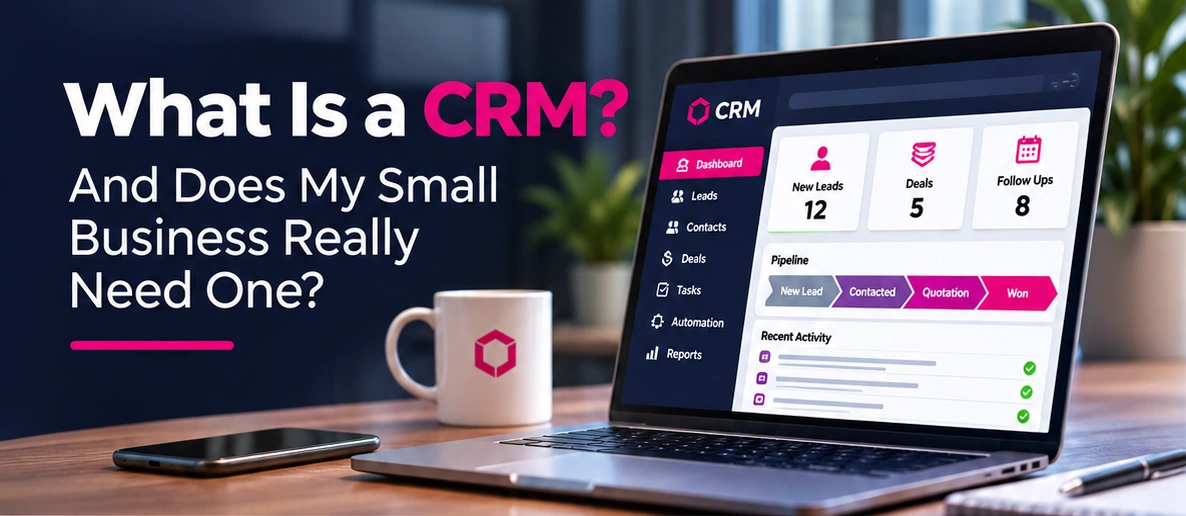
You can track its progress from a new enquiry to a quotation, follow-up and hopefully a confirmed sale.
5. Follow-ups can be automated
Depending on how your system is configured, the CRM can send acknowledgement emails, schedule reminders and help your team keep conversations moving.
The result is a much more organised way of managing potential customers, without relying entirely on memory or a crowded inbox.
Five Reasons a CRM Can Benefit Your Small Business
1. Stop Losing Potential Customers
One of the biggest challenges for small businesses isn't necessarily generating enquiries.
It's making sure those enquiries are dealt with properly.
When messages arrive through email, website forms, phone calls and social media, it's surprisingly easy for something to slip through the cracks.
A CRM brings enquiries into a central system, making it easier to see who needs a response and what needs to happen next.
Every enquiry represents a potential opportunity. A CRM helps you give each one the attention it deserves.
2. Save Time on Repetitive Tasks
How much time do you spend sending the same emails, chasing quotations or reminding yourself to contact customers?
Many of these repetitive tasks can be simplified through CRM automation.
For example, when someone completes a website enquiry form, your CRM could automatically send a confirmation email, notify your sales team and create a task to follow up.
You can also set reminders for outstanding quotations or schedule appropriate follow-up messages.
This doesn't mean removing the personal touch from your business.
It means spending less time on administration and more time actually helping your customers.
3. Keep Everything Organised
As your business grows, keeping track of conversations becomes increasingly difficult.
One customer might have contacted you through your website. Another has sent three emails, and someone else has spoken to a colleague over the phone.
A CRM helps bring this information together.
You can see previous conversations, contact details, quotations, notes and the current status of an enquiry.
This is particularly useful when more than one person deals with customers.
Rather than asking colleagues for updates or searching through different inboxes, everyone with the appropriate access can work from the same information.
4. Understand Where Your Enquiries Are Coming From
You're investing money in your website, Google Ads, SEO or social media marketing.
But do you actually know which activities are generating customers?
A properly configured CRM can help you understand where enquiries originate and what happens to them afterwards.
For example, you might discover that Google Ads generates plenty of enquiries, but visitors arriving through organic search are more likely to become paying customers.
Or perhaps one particular landing page consistently generates better-quality leads than the rest of your website.
This information helps you make more informed marketing decisions.
Rather than guessing what's working, you can start using real data to guide your investment.
5. Turn More Enquiries Into Sales
Getting an enquiry is only the beginning.
For many businesses, customers don't make a decision immediately.
They might request several quotations, need approval from a colleague or simply require more time to consider their options.
A CRM helps you manage that journey.
By tracking where each potential customer sits in your sales process, you can identify opportunities that need attention.
You might have ten quotations waiting for a response, five customers who need a follow-up call and three enquiries ready to proceed.
Without a clear system, those opportunities can easily be forgotten.
With a CRM, you have a much better picture of what's happening and what needs to happen next.
Do I Really Need a CRM if I'm Only a Small Business?
This is probably the most common question we hear when discussing CRM systems with smaller businesses.
And the answer is: not every business needs a complicated CRM system, but many could benefit from a simple one.
If you only deal with a handful of customers and have a reliable way of managing every conversation, your existing processes might be perfectly adequate.
However, if you're regularly receiving enquiries, preparing quotations or following up with potential customers, a CRM could make a significant difference.
Ask yourself:
- Have I ever forgotten to follow up on a quotation?
- Do customer enquiries arrive through several different channels?
- Do I struggle to remember when I last contacted someone?
- Would it help to see all my potential sales opportunities in one place?
- Am I spending too much time on repetitive administration?
- Do I know which marketing activities are generating actual customers?
If you've answered yes to several of these questions, it's probably worth exploring what a CRM could do for your business.
Can a CRM Connect to My Existing Website?
Absolutely. In fact, this is where things can become particularly useful.
Your website and CRM shouldn't have to operate as two completely separate systems.
When they're connected, your website becomes more than somewhere customers can read about your services.
It becomes part of a system designed to generate and manage new business.
For example, a potential customer could:
- Discover your business through a Google search.
- Visit a dedicated page on your website.
- Complete an enquiry form.
- Receive an automatic acknowledgement.
- Have their details added to your CRM.
- Receive a follow-up from your team.
Meanwhile, you can track the enquiry through your sales process and understand which marketing activity helped generate it.
Depending on the CRM platform, integrations and tracking configuration, you may also be able to connect WhatsApp, appointment calendars, email campaigns and other communication tools.
The aim is to create a smoother experience for both your customers and your team.
A Real Example: Chester Vehicle Graphics
At Elygra Marketing, we've put this approach into practice with Chester Vehicle Graphics.
Rather than simply creating a website and leaving the business to manage enquiries separately, we've worked on connecting its digital marketing and customer communication processes.
The system brings together dedicated landing pages, enquiry forms, WhatsApp communication, AI-assisted customer interactions and a CRM for managing incoming opportunities.
When a potential customer makes an enquiry through a connected channel, the information can be recorded and managed through a structured sales pipeline.
This makes it easier to track new leads, manage quotations and keep on top of follow-ups.
It's a practical example of how a website, digital marketing and CRM can work together to support business growth.
Read our Chester Vehicle Graphics case study to learn more about the project.
Is a CRM Expensive?
Not necessarily.
CRM systems range from free or relatively inexpensive platforms through to sophisticated solutions designed for large organisations.
The cost depends on the features you need, the number of users and the level of automation or integration required.
For a small business, the most important thing isn't choosing the system with the longest list of features.
It's choosing something that fits how your business actually works.
There's little benefit in paying for complicated software that nobody in your team understands or uses.
A straightforward CRM that's properly configured around your sales process can be far more valuable than an expensive system full of features you don't need.
It's also worth considering the cost of not having an effective process.
If forgotten enquiries and missed follow-ups are costing your business potential sales, improving how you manage those opportunities could be a worthwhile investment.
A CRM Won't Replace Good Customer Service
It's important to remember that a CRM isn't a magic solution.
Simply installing software won't automatically generate more customers or improve your sales.
You still need a good website, effective marketing, clear communication and a team that responds to enquiries.
What a CRM does is support those activities.
It helps organise information, reduce unnecessary administration and make it easier to provide a consistent customer experience.
Used properly, it should make your business feel more personal and responsive, not less.
So, Does Your Small Business Really Need a CRM?
If you're managing a growing number of enquiries, struggling to keep track of quotations or spending too much time chasing information, a CRM is certainly worth considering.
You don't need a huge sales team or hundreds of customers to benefit.
Sometimes, the biggest improvement comes from simply knowing who has enquired, what they've asked for and when you need to contact them again.
And when your CRM is connected to your website and marketing activities, you can start building a more joined-up approach to attracting and converting new customers.
Let's Make Your Website and Marketing Work Smarter
At Elygra Marketing, we believe your website should do more than look professional.
It should help generate enquiries, support your sales process and contribute to the growth of your business.
That's why we look at the bigger picture, bringing together website design, digital marketing, lead generation and CRM systems to help businesses make better use of their opportunities.
Whether you're looking to introduce your first CRM, automate your enquiry process or connect your existing website to a smarter system, we can help you explore the options.
Want to Spend Less Time Chasing Enquiries and More Time Growing Your Business?
Let's have a conversation about how a CRM could work for your business.
Get in touch with Elygra Marketing and discover how we can help turn more enquiries into customers.
Let’s make something
great happen.
Tell us where you want to go. We’ll bring honest advice, fresh ideas and a clear view of how we can help.
Book a free discovery call ↗