
Menu +
SEO or Google Ads:
Which Is Right for Your Business?
A practical guide to choosing where to invest your marketing budget — and when the two work best together.
You want more people to find your business online. You know Google plays a part, but deciding where to spend your budget can feel less straightforward.
Should you invest in search engine optimisation, run Google Ads, or do a bit of both?
The right starting point depends on what you sell, how quickly you need enquiries and what you can realistically invest. Before choosing a channel, you need to understand what each one can do for your business.
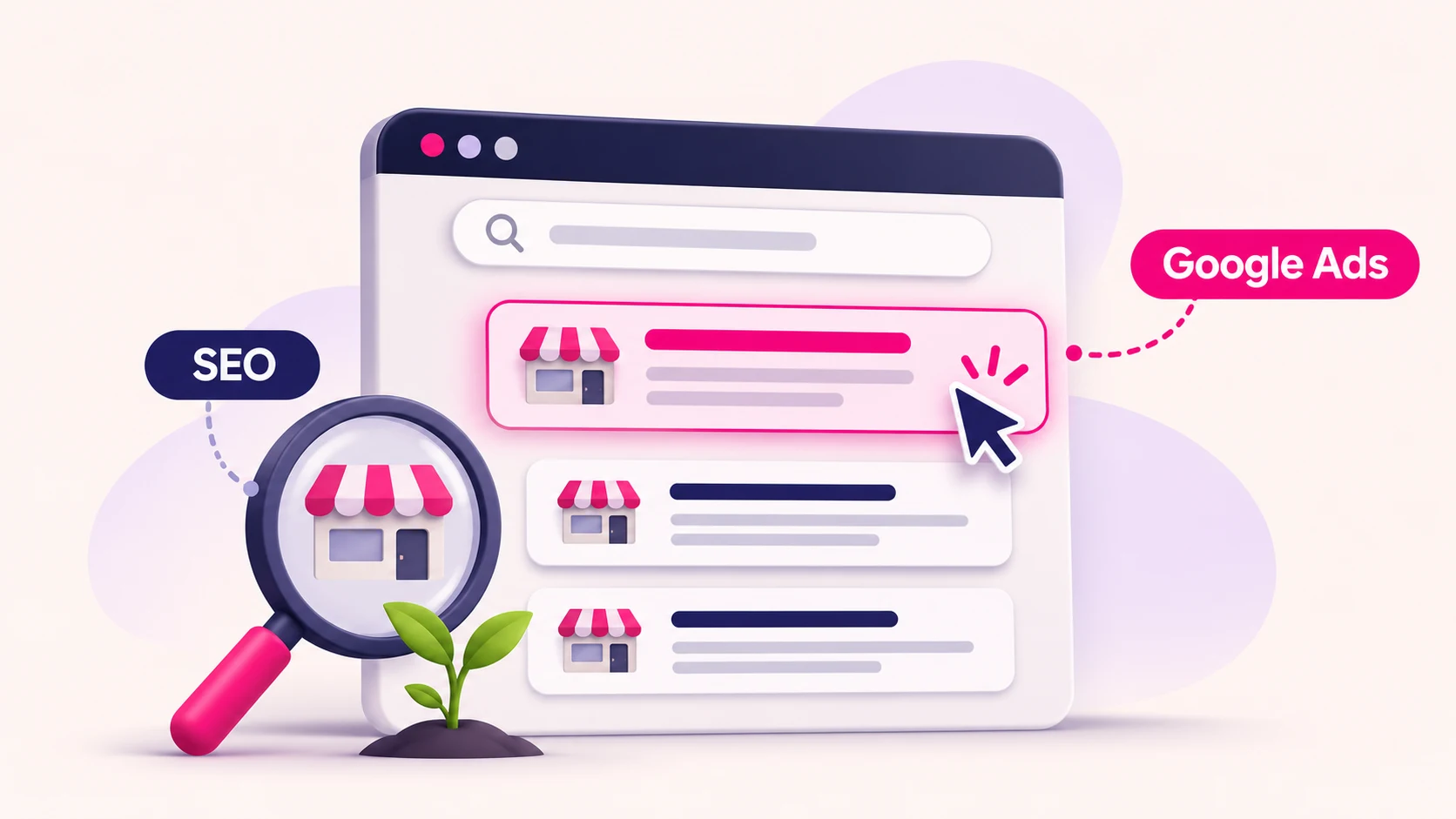
What is the difference between SEO and Google Ads?
Search engine optimisation — usually shortened to SEO — is the work involved in helping your website appear in relevant unpaid search results. That includes creating useful service pages, improving your website’s structure and making your content clear to both customers and search engines.
Google Ads is Google’s advertising platform. For this comparison, we’re focusing on Search campaigns: adverts that can appear when someone searches for products or services related to your business. Google Ads also offers other campaign types, which work differently.
With SEO, you invest in your website’s organic visibility. With Search ads, you pay for advertising and typically incur a cost when someone clicks your advert.
Paying for Google Ads does not improve your organic rankings. The advertising and organic search systems are separate.[1]
SEO: building visibility over time
Imagine you run a roofing company in Chester. You want people looking for roof repairs in your area to find a page that explains your service, shows your work and makes it easy to request a quote.
An SEO plan might involve improving that service page, answering common customer questions, making the site easier to navigate and fixing technical issues that prevent search engines from accessing important content.
For a local business, maintaining an accurate Google Business Profile is another useful part of being found nearby. Local map visibility and ordinary website rankings have different considerations, so both deserve attention.
When SEO can be a good fit
SEO is worth considering when your services are established, people actively search for them and you want to build a lasting source of relevant website visits.
It can be particularly useful if your website currently says very little about the services you most want to sell. A strong, informative page can help customers understand your offer as well as support your search visibility.
What to be realistic about
SEO takes work, and the timing varies. Google explains that some changes can have an effect within hours, while others can take several months. Improvements do not guarantee a particular ranking or an increase in enquiries.[2]
Organic clicks do not carry an advertising charge, but SEO still has a cost: research, writing, technical work and ongoing attention all take time.
Useful content can continue attracting visitors after it is published, but positions can change. Competitors, customer behaviour and your own website will keep evolving.
Google Ads: reaching relevant searches sooner
Now imagine the same roofing company has capacity for more repair work this month.
A focused Search campaign could target relevant searches in the areas the business serves, with adverts leading to a dedicated roof repairs page.
Once a campaign is approved and eligible to run, it can begin reaching people without waiting for that page to earn organic visibility. However, being able to launch quickly does not mean a campaign will immediately be profitable.
When Google Ads can be a good fit
Search ads can make sense when you have a clear offer, want to promote a particular service or need to test whether relevant searches can generate viable enquiries.
They also give you controls over your campaign budget, targeted locations and the searches you want to reach. Those settings need careful management: paying for a click is only useful if it brings a realistic potential customer.
What to be realistic about
Your budget needs to cover advertising spend as well as any setup, management and landing page work.
Click costs vary between markets and searches. A campaign that looks affordable in one industry may need a very different budget in another.
When you pause advertising, that campaign stops bringing in new paid traffic. And while clicks show that people are visiting, they do not tell you whether those visitors are a good fit or whether the work they generate is profitable.
SEO versus Google Ads at a glance
| Question | SEO | Google Search ads |
|---|---|---|
| What are you investing in? | Your website’s unpaid search visibility | Advertising placements for relevant searches |
| How quickly can it help? | Timing varies; meaningful improvements can take months | Can reach searches once approved and running; profitable performance takes testing |
| Do you pay Google for each organic visit? | No | Search ads typically charge for clicks |
| What work is involved? | Content, site structure, technical improvements and review | Campaign setup, targeting, adverts, landing pages and optimisation |
| What happens when spending stops? | Existing pages may still attract visits, but performance can change | The paused campaign stops generating new paid traffic |
| Are enquiries guaranteed? | No | No |
What if you have a limited budget?
Start with one commercially useful goal. For example: generate more enquiries for a particular service within an area you can comfortably cover.
Then look at your starting position.
If your website already attracts relevant searches, improving a key service page may be a sensible first investment. If you need to test a specific offer sooner and can fund a meaningful advertising trial, a focused Search campaign may be more appropriate.
If very few people search for what you sell, neither channel may be your best first move. You might need to build awareness through other marketing activity before customers know what to look for.
Avoid spreading a small budget across too many services, locations and campaigns. Give your chosen approach enough attention to learn something useful, with an agreed review point and a clear measure of success.
When using both makes sense
SEO and Google Ads can support the same business goal in different ways.
For example, a company might run Search ads for one priority service while improving the website’s longer-term organic visibility. Advertising can help test messages and identify searches that bring useful enquiries. Those findings can inform future content, although paid campaign results do not guarantee organic performance.
Organic search data can also reveal services and questions worth exploring in a campaign.
The decision to use both should follow the opportunity and the available budget. Two channels are only useful if you can manage and assess them properly.
Judge the result by the business it brings
Before investing, decide what a worthwhile enquiry looks like and what you can afford to spend acquiring a customer.
Consider this illustrative example: a campaign spends £600 and generates 20 enquiries. That is £30 in advertising spend per enquiry. If four become customers, the advertising cost per customer is £150.
That figure excludes management fees and other costs. Whether it represents good value depends on the profit from those customers, the work involved and any realistic repeat business.
The same thinking applies to SEO. Assess the cost of the work against the relevant enquiries and customers it helps generate over a suitable period.
Track meaningful actions such as quote requests, relevant calls and bookings. Where possible, connect those enquiries to sales so you can judge quality alongside volume.
And make sure the page people arrive on gives them what the advert or search result promised. Our article on why your website might be getting visitors but no enquiries explains what to check once someone lands on your site.
So, which should your business choose?
Consider SEO first if you want to strengthen an established service offering and can invest over time.
Consider Google Search ads first if you have a specific offer to promote, want to reach relevant searches sooner and can budget for testing and ongoing management.
Consider both when there is a clear role for each and enough budget to do the work properly.
The starting point is your business: what you want to sell, who you want to reach and what a new customer is worth to you.
Need help deciding where to start?
At Elygra Marketing, we help businesses in Chester, Cheshire, North Wales and beyond plan and improve their digital marketing.
We can review your website, search visibility and advertising opportunities, then recommend practical priorities around your goals and budget.
For an example of how we bring websites and campaigns together, read our Chester Vehicle Graphics case study.
Tell us about your business and what you want to achieve. Let’s work out your next step.
Sources and further reading
- Google Ads Help: About measuring paid and organic search results
- Google Search Central: SEO Starter Guide
- Google Ads Help: How Google search results differ from ads
Guidance checked 23 November 2026. Examples and channel recommendations are Elygra Marketing’s practical guidance; results depend on the business, market and implementation.
Let’s make something
great happen.
Tell us where you want to go. We’ll bring honest advice, fresh ideas and a clear view of how we can help.
Book a free discovery call ↗